Dispersion and Uniformity
The big-rotor design reduces the working clearance between the rotors, increasing compression and shear applied to the material to support more uniform mixing of fillers and base materials.

KNEADER MACHINERY · BR SERIES
Low-Temperature Mixing, Enhanced Heat Exchange and A/B One-Pass Process Evaluation
KNEADER's BR Series is designed for mixing and kneading rubber, plastic and chemical materials. Its big-rotor configuration and enhanced cooling design aim to improve dispersion uniformity, control temperature rise during mixing, and support A/B One-Pass process evaluation for suitable formulations.
Manufacturer: KNEADER MACHINERY CO., LTD. | Joint Exhibition Page for TaipeiPLAS 2026
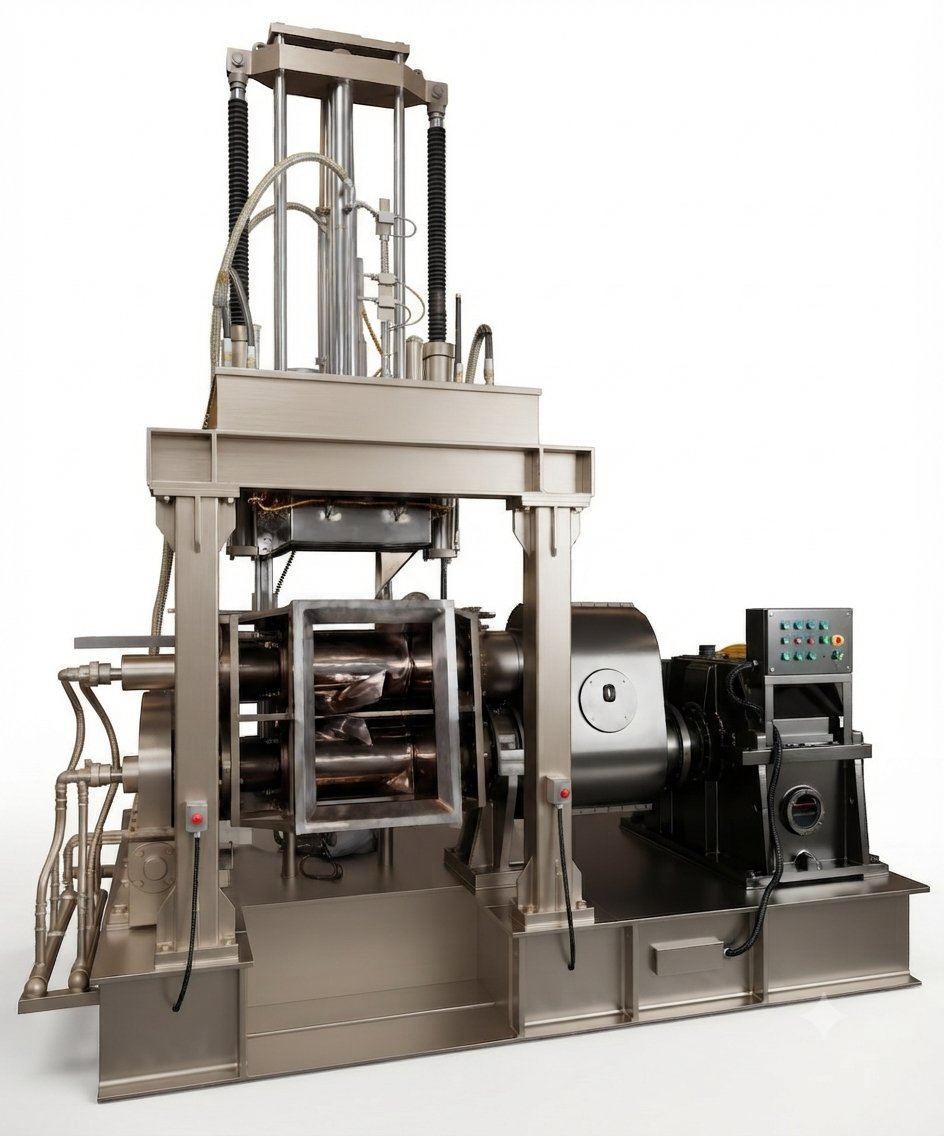
Selecting a dispersion kneader involves more than nominal mixing capacity and main motor power. Dispersion uniformity, batch temperature control, ease of cleaning and color change, and compatibility with downstream sheeting or pelletizing equipment all affect real production performance.
The big-rotor design reduces the working clearance between the rotors, increasing compression and shear applied to the material to support more uniform mixing of fillers and base materials.
Enhanced rotor cooling helps manage the temperature rise generated under high-shear mixing conditions, making the system suitable for formulations that require controlled discharge temperature.
KNEADER's official product information highlights easy operation and easy color change, making the machine worth evaluating for production environments with frequent formulation or color changes.
When the formulation and temperature window allow, A/B One-Pass mixing can be evaluated to reduce cooling delays, re-feeding and batch handling.
The BR Series combines dispersion and temperature control within the same design concept. The larger rotor diameter increases mechanical action on the material, while the cooling structure helps remove heat generated during mixing.
BR Big-Rotor Mixing Chamber
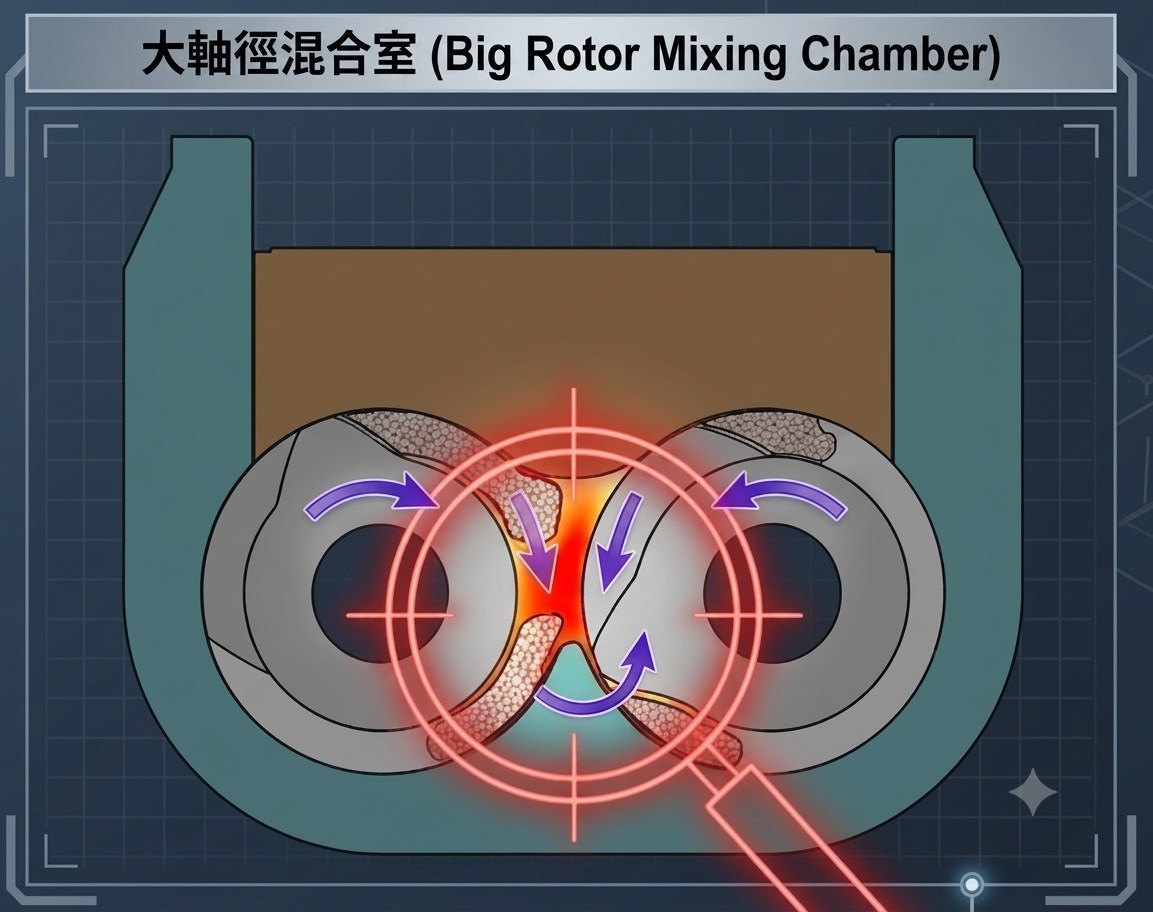
The large-diameter rotors subject the material to compression and shear within a smaller working clearance. This configuration can be evaluated for formulations that require improved filler dispersion or batch uniformity.
Standard Mixing Chamber
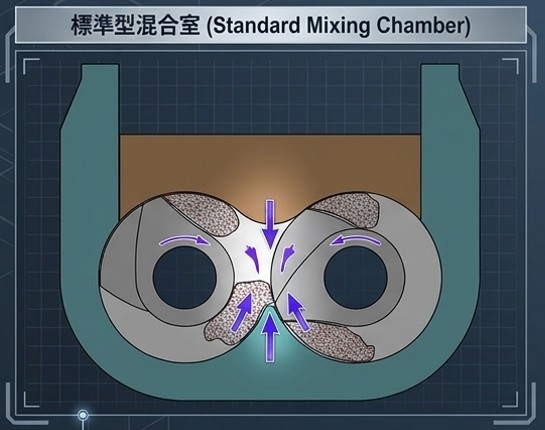
The standard rotor configuration has a larger working clearance and serves as a baseline for general mixing and kneading applications. Final selection should be based on the material, filler ratio, batch weight and required quality standard.
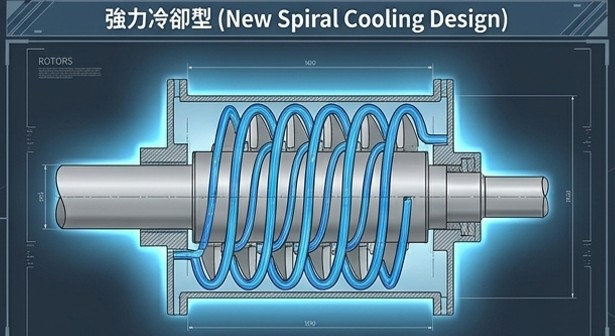
New Spiral Cooling Design
The spiral cooling channel is arranged along the rotor working area to increase contact between the cooling medium and the rotor heat-exchange surface, helping reduce localized areas of insufficient heat transfer.
Actual dispersion quality and discharge temperature are also affected by the formulation, filler ratio, rotor speed, fill factor, batch weight and cooling-water conditions. Material trials or actual process data should be used to confirm suitability before production implementation.
Conventional rubber compounding often separates masterbatch mixing from final curative mixing in order to manage compound temperature and curative reaction. With its dispersion and cooling capability, the BR Series allows suitable formulations to be evaluated for A/B One-Pass mixing. It can also be evaluated for B-stage final mixing in the kneader, potentially reducing the need for a separate two-roll-mill final-mixing step. Suitability must still be confirmed against the formulation and required quality standards. More complex formulations, such as foamed crosslinked compounds, may also be evaluated for completion in a single kneading process.
KNEADER positions the Supercooling Dispersion Kneader Mixer Machine for mixing and kneading rubber, plastic and chemical materials. The company also provides turnkey planning that can cover weighing, feeding, kneading, sheeting, pelletizing, cooling and collection.
Applications may include masterbatch mixing, final mixing, rubber sheeting or rubber pellet production. Key evaluation points include discharge temperature, curative system and dispersion quality.
Suitability should be evaluated according to resin type and the proportions of powders, pigments, fillers and additives. The mixing process can be integrated with downstream extrusion and pelletizing equipment.
KNEADER's overall solution portfolio includes Thermoplastic Vulcanizate (TPV), BMC Mixed Extrusion, Degradable Material Mixing and Granulation, Powder Metallurgy Mixing and Granulation, and EVA/PE Foam Recycling. Whether the BR Series is suitable for a specific process should be evaluated case by case.
The production line can integrate raw-material conveying, small or large-volume automatic weighing, kneading, sheeting or pelletizing, cooling, screening and storage.
The applications above summarize KNEADER's broader product and solution portfolio. They do not mean that the BR Series is required for every material. Please provide formulation and current process data so that the manufacturer can evaluate the appropriate machine and production-line configuration.
More complete process information makes it easier to determine the required mixing capacity, main motor power, cooling configuration, ram system and downstream equipment.
The specifications below are compiled from KNEADER's official Supercooling Dispersion Kneader Mixer Machine product page. Actual motor power, control system, cooling configuration, contact-part materials and ram configuration are subject to the final quotation and technical confirmation.
| Model | Mixing Capacity | Main Power | Tilting Motor Power | Tilting Angle | Temperature Control |
|---|---|---|---|---|---|
| KD-3-20 | 3 L | 20 HP | 1/2 HP | Max. 130° | Automatic |
| KD-5-30 | 5 L | 30–40 HP | 1/2 HP | Max. 130° | Automatic |
| KD-10-60D | 10 L | 60 HP | 3 HP | Max. 130° | Automatic |
| KD-20-100D | 20 L | 60–100 HP | 3 HP | Max. 130° | Automatic |
| KD-35-150D | 35 L | 100–150 HP | 5 HP | Max. 130° | Automatic |
| KD-55-250D | 55 L | 200–250 HP | 7.5 HP | Max. 130° | Automatic |
| KD-75-300D | 75 L | 250–300 HP | 10 HP | Max. 130° | Automatic |
| KD-110-400D | 110 L | 350–400 HP | 10 HP | Max. 130° | Automatic |
| KD-150-600D | 150 L | 500–600 HP | 15 HP | Max. 130° | Automatic |
Swipe horizontally to view the full table.
| Comparison Item | Standard STD | Big-Rotor BR |
|---|---|---|
| Dispersion Quality | Good | ★★★★★ Excellent |
| Cooling Efficiency | Standard | High-Efficiency Spiral Cooling |
| Ram System | Standard Pneumatic Ram | Hydraulic Ram Recommended, up to 2× pressure according to vendor-provided comparison data |
| Rubber One-Pass Mixing | Not available | Can be evaluated depending on formulation |
| Power and Structure | 150 HP, lighter-duty structure | 200–300 HP, heavy-duty high-rigidity structure |
Swipe horizontally to view the full table.
KNEADER MACHINERY CO., LTD. was established in 1981 and, according to the company's official profile, was the first manufacturer of Dispersion Kneaders in Taiwan. KNEADER has accumulated experience from more than 4,000 machines and operates laboratories at its Taiwan headquarters and KMC USA to support material testing, machine development and turnkey process planning.
KNEADER's product portfolio covers dispersion kneading, extrusion and pelletizing, sheeting, cooling, weighing, conveying and turnkey production-line planning. The BR Series is the big-rotor, enhanced-cooling configuration within its Dispersion Kneader Mixer Machine range.
KNEADER positions this series for mixing and kneading a wide range of rubber, plastic and chemical materials, including formulations that may benefit from low-temperature mixing. Actual suitability should still be confirmed according to the material and filler ratio.
No. Whether masterbatch and final curative mixing can be combined depends on the curative system, discharge temperature, mixing time, fill factor and required quality standard. We recommend providing formulation data or arranging a material trial first.
Nominal chamber capacity alone is not sufficient. Material density, batch weight, recommended fill factor, rotor configuration, main motor power and required mixing time should all be considered.
Yes. KNEADER's products and solutions cover raw-material conveying, weighing, kneading, extrusion, pelletizing, sheeting, cooling and collection. The final scope should be defined according to the specific project requirements.
Please prepare the material and formulation type, batch weight, target discharge temperature, current mixing time, quality issues, discharge form and required production capacity. More complete information allows faster evaluation of the machine model and production-line configuration.
We can help organize your material, batch-weight, temperature and production-line requirements so that the KNEADER team can evaluate the appropriate BR Series model, cooling configuration and upstream/downstream equipment.
Book an On-Site ConsultationTo help us respond efficiently, please provide your material, batch mixing weight, target temperature and current process challenges whenever possible.
Thank you for contacting us. We will get back to you as soon as possible.
KNEADER MACHINERY CO., LTD.
Address: No.2, Ln. 81, Niaosong 3rd St., Yongkang Dist., Tainan City 710, Taiwan
Tel: +886-6-2438586
Fax: +886-6-2434205
Email: sales@kneader.com.tw
Website: www.kneader.com.tw